Politics & Government
Transitway to Alter Route 1 Intersections
Bus Rapid Transitway construction expected to begin in July.


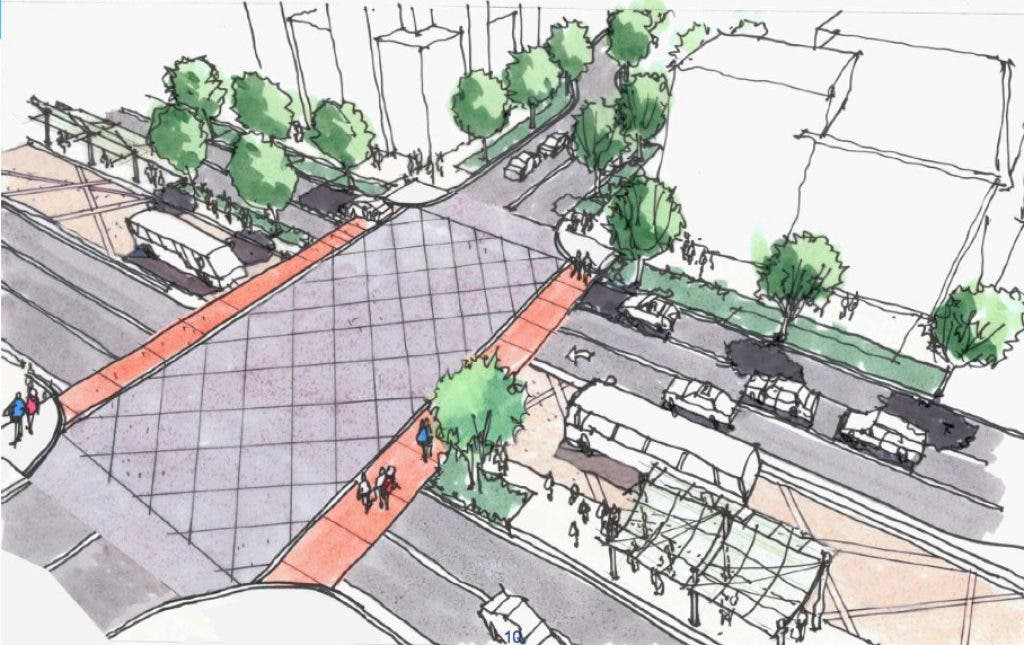
The creation of the Crystal City-Potomac Yard transitway will alter the layout of Route 1 to offer fast, reliable and safe bus service, project planners said at a community meeting Wednesday at .
The Bus Rapid Transitway in Alexandria will consist of exclusive bus lanes in the median of Route 1 between Potomac Avenue and E. Glebe Road. The transitway will eventually connect Braddock Road and Pentagon City Metro stations. Work is being performed in partnership with Arlington County.
The northbound lanes of Route 1 are currently being expanded. To create the BRT, the existing northbound lanes will be repurposed with concrete for a two-lane bus way. There will be 12-foot landscaped medians on either side of the BRT lanes that will taper near intersections with signalized left-turn lanes.
Find out what's happening in Del Raywith free, real-time updates from Patch.
Within the Alexandria segment, the transitway will have seven stations—three on the northbound side and four on the southbound side.
BRT station locations on Route 1 in Alexandria include:
Find out what's happening in Del Raywith free, real-time updates from Patch.
- E. Glebe Road (southbound only, northbound located in Potomac Yard)
- E. Swann Avenue, two stations
- E. Custis Avenue, two stations
- Potomac Avenue, two stations
The stations, which will be built on a separate contract, will include display boards showing real-time arrivals. The MetroBus 9S route will utilize the transitway, as will a new 9X route. Headways will be 12 minutes during peak hours, 15 minutes on off-peak hours and 20 minutes on weekends. Service will operate on a prepay basis so users can just hop on the bus.
Pedestrians will only be able to cross Route 1 at countdown crosswalks near the station locations and Howell Avenue. Emergency vehicles will be able to mount the curb and access the BRT lanes, project manager Susan Gygi said.
The Alexandria portion is being funded by $8.5 million in federal stimulus money.
Construction of the BRT, which is expected to begin in July, will alter several intersections along the eight-tenths-of-a-mile stretch in Alexandria.
The traffic signal at Hume Avenue will be removed and the intersection will become right-in, right-out only. Right-in, right-out will also be required at Raymond, Windsor and Bellefonte avenues.
Intersections at Potomac Avenue and E. Glebe Road will also be altered to allow the buses to connect and exit the BRT lanes.
At Wednesday's meeting, citizens expressed concerns about people parking on Del Ray streets to access the bus line.
Del Ray resident David Fromm suggested city staff be proactive and implement a parking district before the expected start of BRT service in December 2013 to prevent BRT users from driving in from elsewhere to park near stations.
“Based on the operation of a BRT, we don’t anticipate any parking issues,” Alexandria Transportation and Environmental Services Deputy Director Abi Lerner said.
T&ES Director Rich Baier said staff will respond to any problems as they arise.
“It only takes 30 days to create a parking district,” he said.
Planners said they hoped the BRT would maintain the urban boulevard character of Route 1 and set a standard for other transit corridors in the city.
The Alexandria Planning Commission will hold a public hearing about the BRT on May 1.
Get more local news delivered straight to your inbox. Sign up for free Patch newsletters and alerts.


